Operation Osprey
w/ 45 Commando Royal Marines-
Unit scale & type
45 Commando Royal Marines, **** and ****** .
-
Duration / Location
Dec 2025 / Seeing Systems’ Training Range, UK

-
Participants
Over 30 Individual FPV OWE Operators from elite UK military units
30+
-
100%Participant completion
All participants able to safely and effectively fly targeted operations by end of session
-
2-3 FlightsHands-on training
Each operator completed a minimum 2 full-battery flights.
-
25+minsFlight time
25+ minute flight time recorded (training configuration, no payload). No downtime.
-
-1°C to +10°CConditions
System held up effectively under temperature testing conditions.
A group of elite UK personnel recently put Seeing Systems’ Bandit FPV platform through its paces. The aim was to build real-world one-way effector (OWE) capability from scratch, within a single training window.
In modern conflict, low-cost, attritable FPV systems are reshaping the battlefield. This field activity helped close that gap. In just one intensive day, operators moved from first-time handling to confidently carrying out targeted strike runs. At the same time, Seeing Systems captured frontline feedback to help shape the next generation of UK OWE capability.
One-way effector (OWE) capability is not yet fielded by the UK Armed Forces, and personnel lack practical experience with FPV systems that are proving decisive in contemporary conflict.
Without structured exposure and repetition, operators risk entering future engagements without the instinctive stick skills, confidence, and tactical understanding required to deploy these systems effectively.
The Bandit FPV platform mirrors the low-cost, attritable OWE systems deployed in Ukraine. Fielding our testing systems with elite units allowed Seeing Systems to train operators while simultaneously gathering requirements tailored to a next-generation UK Armed Forces OWE system.
Field support requirements:
- Parallel charging setup enabled continuous rotation of personnel with minimal downtime.
- Seeing Systems provided all charging infrastructure and spare parts.
- Carbon-fibre frame proved durable across multiple novice pilots with no structural failures.
Embedded, Operational Delivery Model:
- Seeing Systems staff operated as embedded trainers
- Royal Marines personnel rotated through flight stations.
- Each participant received individual briefings before their flight sessions.
- Soldiers fixed their own kit, replacing broken propellers, carrying out safety checks, etc.
- By the end of the day, commandos were flying safely and proficiently into targets.
Flight Cycles:
- Minimum 36 battery cycles (18 personnel × 2 batteries each).
- 2-3 flights per soldier.
- At least one run using digital hardware, and one run using analog hardware, to experience the full range of real-world deployed hardware.
- Mix of introductory flights for complete novices and more advanced manoeuvring and strike runs (including target impact) for those with prior experience.
Operational Focus:
- Manual flight only – focus on building fundamental stick skills and spatial awareness.
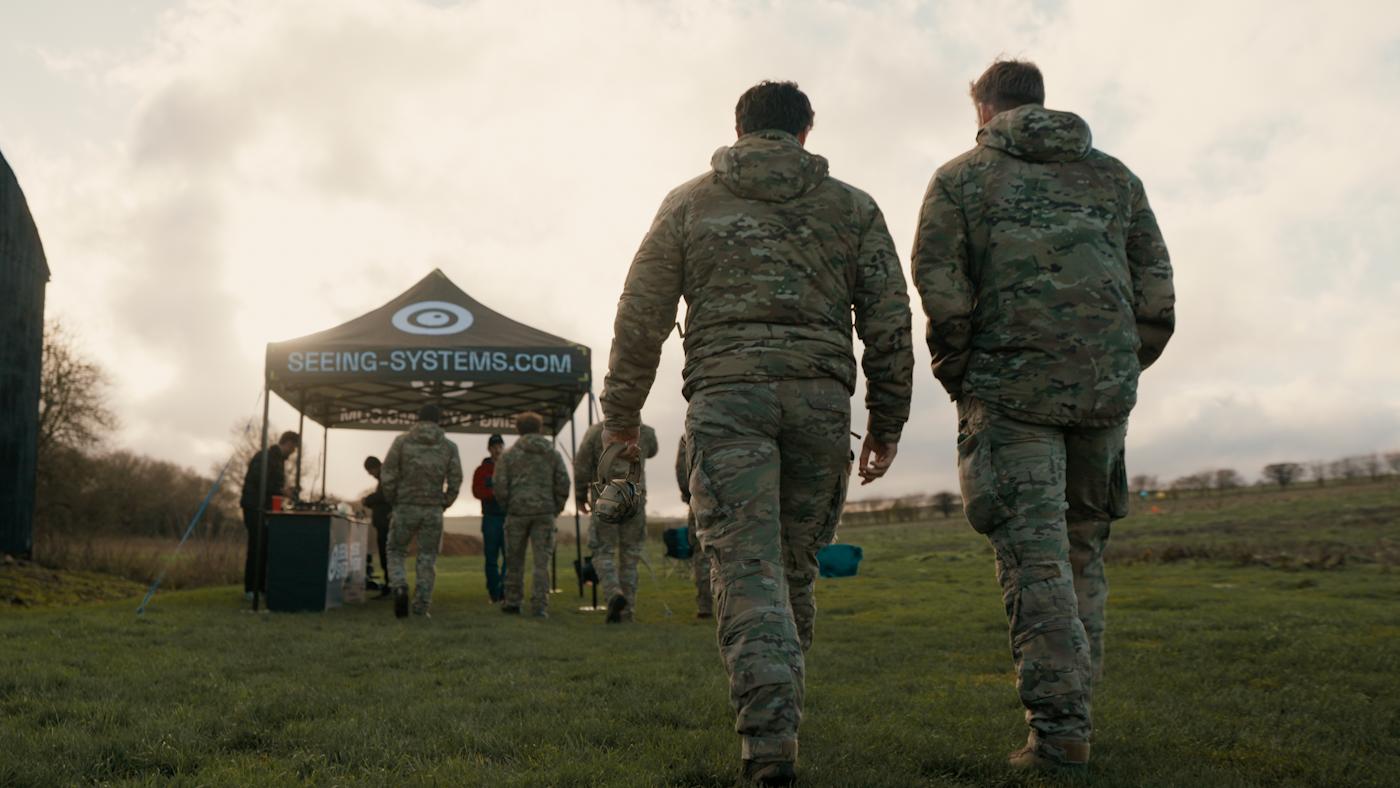

During the 8-hour session, 18 personnel were trained to operational standard. 100% of participants were able to safely and effectively fly targeted operations by end of session.
Each operator completed a minimum 2 full-battery flights.
Mission-Level Impact:
- Effective OWE capability achieved within one training day.
- Trainees reliably hit targets less than 30cm in diameter.
- S2 collaborated with 45 Commando Royal Marines to refine UK Armed Forces OWE requirements
The progression curve was immediate and visible. Initial hover and directional control was typically achieved within the first battery. By the end of the eight-hour session, every participant had moved from novice handling to executing controlled, targeted strike runs. Repetition, rapid turnaround between flights, and the expectation that operators maintain and repair their own kit created ownership from the outset.
The presence of the system shifted squad energy almost instantly. Operators leaned in. Discussions about integration into patrol routines and existing tactics emerged organically throughout the day.
Comments from participants reflected the urgency and enthusiasm for this kind of training:
“We need to do way more of this and understand how we can use it”
“It’s brilliant. We all know it’s part of the future”
By the end of the operation, soldiers were self-sufficient enough to coach one another, troubleshooting independently, and feeding structured insight directly into future UK OWE requirements.
Training in the field reveals what slides and simulations never can. These sessions are invaluable for our team.
Problems we faced on the day:
- Hard crashes resulted in multiple broken propellers (frames held up well)
- Damaged batteries became a hazard for transportation post-session
- Dark conditions make it easy to mis-attach propellors.
- Cold weather reduced flight times below optimal
Immediate mitigations were practical and effective:
- Sufficient spare propellers on-site allowed rapid turnaround
- Damaged batteries isolated and handled per Li-Ion safety protocols
- We marked blades so it was easier to see which ones corresponded to which position.
Looking forward, priority refinements are clear:
- Usability of drones for those with no prior experiences – Tool less field repairs
- Cold weather battery warming/insulation for winter training
- We’re designing props that only attach in the correct location, making incorrect attachment impossible.
- The Bandit system integrates with COT’s controllers and goggles (training revealed these weren’t simple to use for many participants). We are working on a much easier solution to solve this problem.
Following the training session, a report was shared with 45 Commando Royal Marines members. A S2 debrief allowed us to prioritise improvements for upcoming training sessions.
Before Operation Osprey:
Personnel had limited or no exposure to FPV systems, viewing them as specialist equipment.
After Operation Osprey:
All participants had flown FPV OWEs and understood that the skill was accessible with proper training, and how effective it can be on a modern battlefield.